
The Advertising Power of Mapping Customer Movement IRL
 0
0
 0
0
Table of Contents
Most companies buying outdoor advertising are flying blind. They pick a billboard, they pay the fee, and they hope. Maybe the sales numbers tick up in the following quarter, maybe they don’t, but proving a direct link between the board on the N1 and a customer signing up at 11pm on their phone? Good luck.
It is a problem that has bugged marketers since the first painted ad went up on the side of a barn. And it is a problem a Wonga South Africa data scientist set about solving recently; by doing something subtly clever with data the company already had sitting in its systems.
The pitch from marketing was straightforward enough. They wanted to know which billboards on offer from ‘Prime Media’ were actually worth the spend. Same board, same creative, but stuck on the N1 in Johannesburg versus the R21 near Pretoria, was always going to perform differently. The trouble is, nobody at Wonga could prove that with any kind of rigour. So the data science team was handed a fairly vague brief: clean up the address data, see what you can do with it.
From spreadsheet to street map
Here is what they had to work with. Every Wonga customer who applies for a loan gives their home address and the name of their employer when they fill out the form. That is two physical anchor points per customer. A starting line and a finish line.
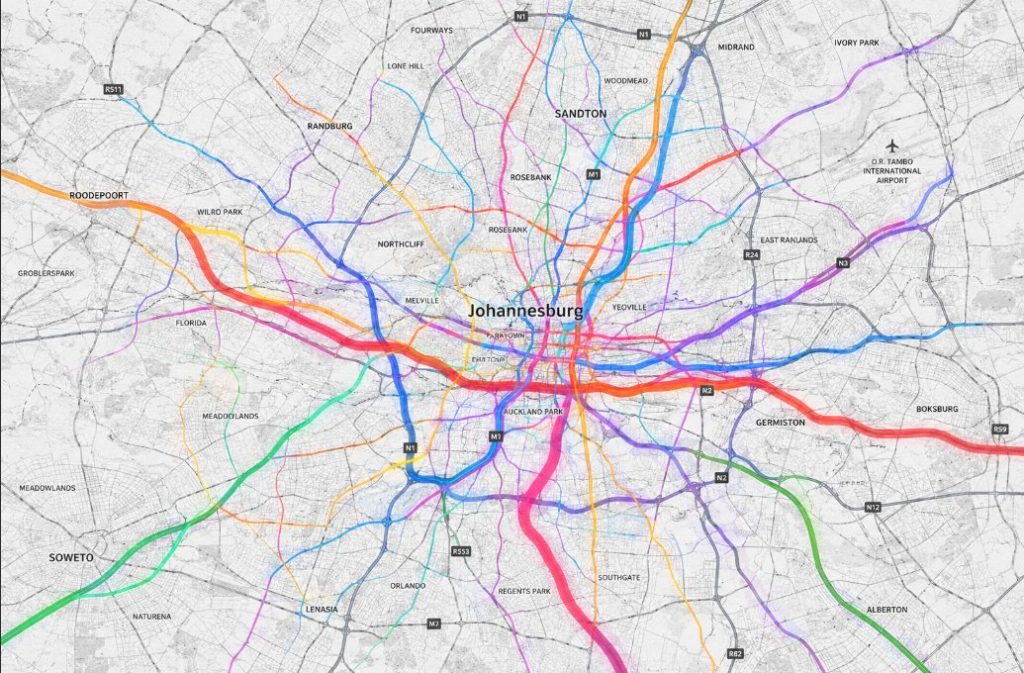
The thinking went something like this: if you know roughly where someone lives and roughly where they work, you can take an educated stab at the route they probably travel between the two. Multiply that across thousands of customers across a city like Johannesburg and you stop seeing individual journeys, you start seeing thick rivers of human movement. And if those rivers happen to flow past a specific billboard, you can put a number on how many of your customers are seeing it every single working day.
That is a marketing attribution model. A messy, imperfect one, sure, but vastly better than the educated guesswork most companies are using.
The annoying middle bit
Plotting two points on a map sounds easy. It is not. The first hurdle was geocoding, which is the dull name for the dull job of turning ’12 Snowflake Street, Jozi’ into actual latitude and longitude coordinates a computer can do something with.
The team tested several APIs. Most of them choked on South African addresses, defaulting to a central point in the city whenever the input wasn’t perfectly formatted. Useless. Google Maps was the only one that consistently delivered accurate coordinates, but the cost of the standard API would have run to well into the thousands of US dollars for the project. Not viable.
The workaround was a bit of digging through Google’s own documentation, which revealed a cheaper geocoding API that did much the same job for a fraction of the price. The total cost dropped from around $1,480 to roughly $200. A useful reminder that the first quote a tech giant offers you is rarely the only one available.
Then came the routing. Drawing a line between home and work, but a realistic line that follows actual roads rather than crow-flies straight across someone’s roof. For this they used a service called Open Route Service which handles the road network calculations and spits back the actual driving path between two coordinates. Rate-limited, but free. Workable.
What the map showed
Once everything was stitched together in a Streamlit app, the marketing team finally got the thing they always wanted: a living, zoomable map of customer movement across South Africa. Billboards plotted as points. Customer routes plotted as lines. The clever bit was making the line thickness scale with volume, so the busiest commuter corridors lit up like arteries.
A billboard near a corridor with 700 customers passing it daily suddenly looks like a very different proposition to one sitting next to a route only thirty people use. Same physical board, same agency rate card, wildly different actual value.
There were quirks. Remote workers messed with the data, so anyone whose home and work were more than 100km apart got filtered out. Common employers like KFC required the team to assume the customer worked at whichever branch was closest to home, which is a reasonable shortcut but not a precise one. Honest about its own limits, the model.
What it actually means
The work is currently translating into real world billboard buying decisions, the ads will be popping up over the coming months, but the principle is what matters. When attribution is treated as a real problem rather than a vague aspiration, even slightly messy data plus a concentrated effort of API wrangling can produce something useful.
For any marketing team still buying outdoor on gut feel, that is a meaningful shift. The customers were telling Wonga where they actually were the whole time. Someone just had to listen.
Related Post
- Small Business Lead Generation: How to Find Your Customers
- Maximizing Visibility: How to Effectively Implement Run of Site in Your Content Strategy
- Reasons To Invest In Customer Experience Management System?
- Some Basic Marketing Strategies Every Marketer Should Follow