
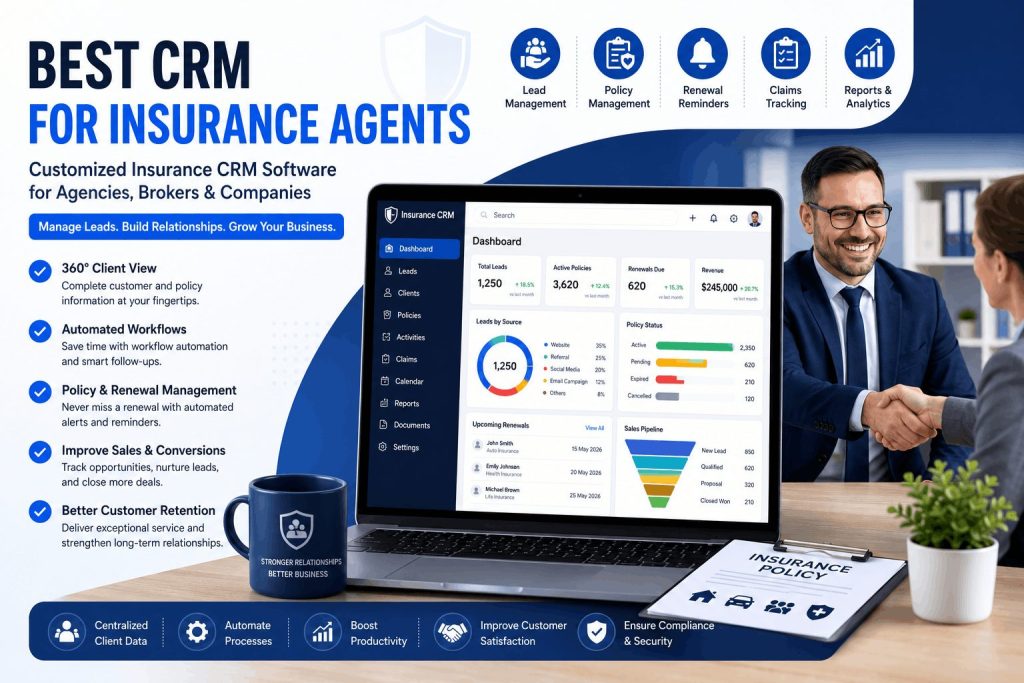
Best CRM for Insurance Agents: Why Customized Insurance CRM Software Matters
 0
0
 0
0
Table of Contents
The insurance industry has become increasingly competitive, making it essential for agencies and brokers to manage customer relationships efficiently while delivering personalized services. From generating leads and tracking policies to managing renewals and claims, insurance professionals handle a wide range of tasks every day. Relying on spreadsheets or disconnected systems often results in missed opportunities, delayed follow-ups, and lower customer satisfaction.
This is where the best CRM for insurance agents becomes a valuable business tool. A modern CRM software for insurance agents centralizes customer information, automates routine processes, and helps sales teams nurture prospects throughout the policy lifecycle. Whether you’re an independent advisor, a brokerage firm, or a large insurer, implementing a reliable insurance client management system can significantly improve operational efficiency and customer retention.
Organizations searching for the best customizable insurance CRM software or the best customized insurance CRM software often look for solutions that can adapt to their business processes. A customized insurance CRM software enables agencies to automate workflows, improve collaboration, and deliver exceptional customer experiences while supporting long-term business growth.
What is an Insurance CRM?
An insurance CRM is a specialized customer relationship management platform built specifically for insurance agencies, brokers, and insurance companies. While traditional CRM systems focus primarily on storing customer information, an insurance CRM software is designed to manage the entire insurance sales and service lifecycle.
A dedicated insurance agency CRM allows businesses to organize customer data, manage leads, monitor policy renewals, automate follow-ups, and maintain long-term client relationships from a single dashboard.
An effective insurance client management system typically includes:
- Lead capture and lead management
- Contact and customer database management
- Policy management and tracking
- Renewal reminders
- Claims follow-up
- Sales pipeline management
- Customer communication history
- Workflow automation
- Reporting and analytics
The biggest advantage of using CRM software for insurance agents is that it provides complete visibility into every customer interaction. Sales representatives can quickly access client information, policy details, previous communications, and upcoming renewal dates, allowing them to provide timely and personalized support.
Unlike generic CRM platforms, a CRM for insurance companies supports industry-specific processes such as policy lifecycle management, commission tracking, regulatory compliance, and customer retention initiatives. This makes it a valuable investment for businesses looking to improve productivity while delivering better customer experiences.
Whether you’re evaluating a cloud-based CRM software for insurance agencies or searching for the best CRM for insurance brokers and agencies, choosing an industry-focused solution helps streamline operations and improve overall business performance.
Key Features of the Best Customized Insurance CRM Software
The best customized insurance CRM software goes beyond traditional customer management by providing intelligent automation, centralized data, and specialized features designed for the insurance industry. Below are some of the essential capabilities every insurance agency should look for.
Lead Capture and Insurance Lead Management
Successful agencies rely on a steady flow of new prospects. An advanced insurance CRM software automatically captures leads from websites, social media, email campaigns, referrals, and online inquiries. This improves insurance lead management by ensuring that every opportunity is recorded and assigned to the appropriate sales representative.
Comprehensive Customer Profiles
A centralized insurance customer management software maintains complete client records, including contact information, policies, communication history, documents, claims, and renewal schedules. Having all customer data in one place enables agents to provide faster and more personalized service.
Policy Tracking and Renewal Management
One of the most valuable features of an insurance CRM is policy management. Agents can monitor policy status, expiration dates, premium payments, and renewal schedules without relying on manual tracking.
Automated renewal reminders help reduce policy lapses while improving customer retention and recurring revenue.
Sales Pipeline Management
Insurance agencies manage prospects at different stages of the buying journey. An integrated insurance sales CRM provides complete visibility into the sales pipeline, enabling teams to prioritize high-value opportunities and forecast future revenue more accurately.
Insurance Workflow Automation
Manual administrative work consumes valuable time. Insurance workflow automation streamlines repetitive processes such as:
- Lead assignment
- Follow-up reminders
- Email notifications
- Policy renewal alerts
- Task scheduling
- Approval workflows
Automation improves efficiency while allowing agents to focus on customer relationships and business development.
Mobile Accessibility
Today’s insurance professionals often work remotely or meet clients outside the office. A cloud-based insurance CRM enables agents to securely access customer information, update records, and manage opportunities using smartphones, tablets, or laptops from anywhere.
Reporting and Analytics
Real-time dashboards provide valuable insights into agency performance, lead conversion rates, policy renewals, customer retention, and sales productivity. These reports help managers make informed business decisions based on accurate data.
AI-Powered Lead Scoring
Many modern platforms now include AI-powered insurance CRM software capabilities that analyze customer behavior, engagement levels, and historical interactions to identify high-potential prospects. This enables agents to prioritize leads with the highest likelihood of conversion.
Benefits of Using CRM Software for Insurance Agents
Implementing CRM software for insurance agents offers significant advantages beyond organizing customer information. It improves productivity, strengthens client relationships, and helps agencies deliver more efficient services.
Better Lead Management
A centralized insurance lead management system ensures every inquiry is tracked from the first interaction to policy issuance. Sales teams can prioritize qualified prospects, schedule follow-ups, and reduce the risk of missed opportunities.
Faster Customer Response
Instant access to customer records, policy information, and communication history allows agents to respond quickly to client inquiries. Faster response times improve customer satisfaction and build stronger long-term relationships.
Improved Policy Renewals
Automated reminders and scheduled follow-ups help agencies contact clients before policies expire. This proactive approach increases renewal rates while reducing customer churn.
Higher Sales Conversion
By combining insurance sales automation, personalized communication, and intelligent lead tracking, agencies can shorten the sales cycle and improve conversion rates.
Centralized Customer Data
An insurance customer management software consolidates all customer information into one secure platform, making collaboration between sales, support, and management teams much easier.
Reduced Administrative Work
Automation eliminates repetitive manual tasks such as data entry, reminders, and workflow approvals, allowing agents to spend more time advising clients and generating new business.
Why Insurance Agencies Need a Customized CRM Solution
While standard CRM platforms are suitable for general customer management, they often lack the specialized functionality required by insurance professionals. Insurance agencies deal with policy renewals, claims management, compliance requirements, commission tracking, and customer retention strategies that demand industry-specific workflows. This is why many organizations prefer investing in a customized insurance CRM software rather than a generic CRM.
A CRM solution for the insurance agencies and brokers is designed to align with the unique operational needs of insurance businesses, enabling agents to manage the entire customer lifecycle more efficiently.
Tailored Workflows
Every insurance agency has its own sales process, approval hierarchy, and service workflow. The best customized insurance CRM allows businesses to customize lead stages, policy workflows, customer fields, and automated processes according to their specific requirements.
Policy-Specific Data Management
Unlike traditional CRM systems, customized insurance CRM software can store policy information, coverage details, beneficiaries, premium schedules, renewal dates, and claim history in a structured format. This makes policy management faster and more organized.
Automated Policy Renewal Reminders
Policy renewals are critical for customer retention and recurring revenue. A best customizable CRM software solution automatically sends reminders to agents and customers before policy expiration, helping agencies improve renewal rates while delivering proactive customer service.
Claims Tracking and Customer Support
Handling insurance claims efficiently is essential for maintaining customer trust. A CRM for insurance companies enables agents to monitor claim status, document communication, and provide timely updates throughout the claims process.
Compliance and Documentation
Insurance businesses operate in a highly regulated environment. Customized CRM solutions help agencies maintain proper documentation, manage compliance-related activities, and securely store customer records, reducing administrative risks.
Multi-Branch and Broker Management
As agencies expand, managing multiple offices or broker networks becomes more complex. A scalable CRM solution for the insurance agencies and brokers allows organizations to manage multiple users, branches, and teams while maintaining centralized control over customer data.
By choosing the best customized insurance CRM software, agencies gain the flexibility to adapt the platform to their business instead of changing their business processes to fit the software.
How to Choose the Best CRM for an Insurance Agency
Selecting the best CRM for an insurance agency requires evaluating both your current business needs and long-term growth objectives. The ideal platform should improve productivity, simplify operations, and provide the flexibility to scale as your agency grows.
Here are the key factors to consider before making your decision:
Ease of Use
A user-friendly interface encourages faster adoption among agents and minimizes the learning curve. The easier the system is to use, the more effectively your team will utilize its features.
Industry-Specific Features
Choose a CRM software for insurance agents that includes insurance-focused capabilities such as policy tracking, renewal management, claims monitoring, commission management, and customer lifecycle tracking.
Automation Capabilities
The best CRM for insurance agents should automate repetitive tasks like lead assignment, follow-up scheduling, policy renewal reminders, email notifications, and workflow approvals. Automation improves operational efficiency while reducing manual errors.
Integration with Existing Systems
A modern insurance agency CRM should integrate seamlessly with:
- Email platforms
- Accounting software
- Marketing automation tools
- Document management systems
- Communication platforms
- Third-party insurance applications
These integrations eliminate duplicate data entry and improve collaboration across departments.
Mobile Accessibility
Agents frequently work outside the office. A cloud-based insurance CRM enables them to access client information, update records, schedule appointments, and manage policies from any device.
Reporting and Analytics
Advanced dashboards and reports provide valuable insights into lead conversion, customer retention, policy renewals, team productivity, and revenue performance. Data-driven reporting helps agencies make informed strategic decisions.
Security and Compliance
Customer data protection is a top priority in the insurance industry. Ensure the CRM offers role-based permissions, data encryption, regular backups, audit trails, and compliance with relevant regulations.
Scalability
Whether you’re a small brokerage or a large enterprise, your CRM should be capable of growing with your business. The best customizable CRM software solution allows agencies to add users, features, and integrations as operational requirements evolve.
Future Trends in Insurance CRM Software
Technology continues to transform the insurance industry, and CRM platforms are evolving rapidly to meet changing customer expectations and business demands.
Artificial Intelligence
AI-powered insurance CRM software is helping agencies automate lead qualification, predict customer behavior, recommend personalized insurance products, and identify high-value sales opportunities.
Predictive Analytics
Predictive analytics enables agencies to forecast customer renewals, identify clients at risk of policy cancellation, and improve sales planning through data-driven insights.
Omnichannel Customer Communication
Customers now interact through email, phone, websites, live chat, messaging apps, and social media. Future insurance sales CRM platforms will unify all communication channels into a single customer profile, creating a seamless customer experience.
Workflow Automation
Insurance CRM with workflow automation will continue reducing administrative workloads by automating document approvals, policy processing, claims updates, and customer follow-ups.
Cloud-Based CRM Solutions
Cloud technology provides secure, real-time access to customer information from anywhere. Cloud-based insurance CRM platforms will remain the preferred choice for agencies seeking flexibility, scalability, and lower infrastructure costs.
Personalized Customer Experiences
Modern CRM for insurance companies is increasingly using customer data to deliver personalized recommendations, targeted marketing campaigns, and customized communication that strengthens long-term customer relationships.
Conclusion
As the insurance industry becomes more competitive and customer expectations continue to rise, investing in the right CRM solution is no longer optional—it’s essential. The best CRM for insurance agents empowers agencies to manage leads, automate workflows, improve customer communication, and streamline policy management from a single platform.
Whether you’re looking for the best customized insurance CRM software, a CRM solution for insurance agencies and brokers, or a scalable insurance client management system, choosing an industry-specific solution can significantly improve operational efficiency and customer satisfaction.
A well-designed customized insurance CRM software simplifies insurance lead management, enhances insurance sales automation, improves policy renewal rates, and provides valuable business insights through advanced reporting and analytics. It also enables agencies to build stronger customer relationships while reducing administrative workload.
By selecting the best customizable CRM software solution that aligns with your agency’s unique processes, you’ll be better positioned to increase productivity, retain more clients, and achieve sustainable business growth in an increasingly digital insurance landscape.
Frequently Asked Questions (FAQs)
1. What is the best CRM for insurance agents?
The best CRM for insurance agents is one that offers industry-specific features such as lead management, policy tracking, renewal reminders, claims monitoring, workflow automation, reporting, and mobile accessibility. It should also be scalable enough to support future business growth.
2. Why do insurance agencies need customized CRM software?
Customized insurance CRM software is designed to meet the unique operational requirements of insurance agencies, including policy lifecycle management, renewal automation, compliance tracking, claims management, and customer retention. It offers greater flexibility than generic CRM platforms.
3. What features should an insurance CRM include?
A comprehensive insurance CRM should include lead capture, insurance client management system capabilities, policy management, contact management, insurance workflow automation, sales pipeline management, reporting and analytics, AI-powered lead scoring, mobile access, and integration with other business applications.
4. Can CRM software improve policy renewals?
Yes. CRM software for insurance agents automates renewal reminders, schedules follow-ups, tracks policy expiration dates, and enables proactive customer communication, helping agencies increase renewal rates and improve customer retention.
5. Is cloud-based insurance CRM suitable for small agencies?
Absolutely. A cloud-based insurance CRM is ideal for small and growing agencies because it offers lower infrastructure costs, secure remote access, automatic updates, scalability, and the flexibility to support expanding teams without significant IT investment.